Article
Trace the Downline
AI systems should be judged by tracing their consequences to human footing: whether they strengthen subsistence, health, capability, and flourishing—or degrade them.
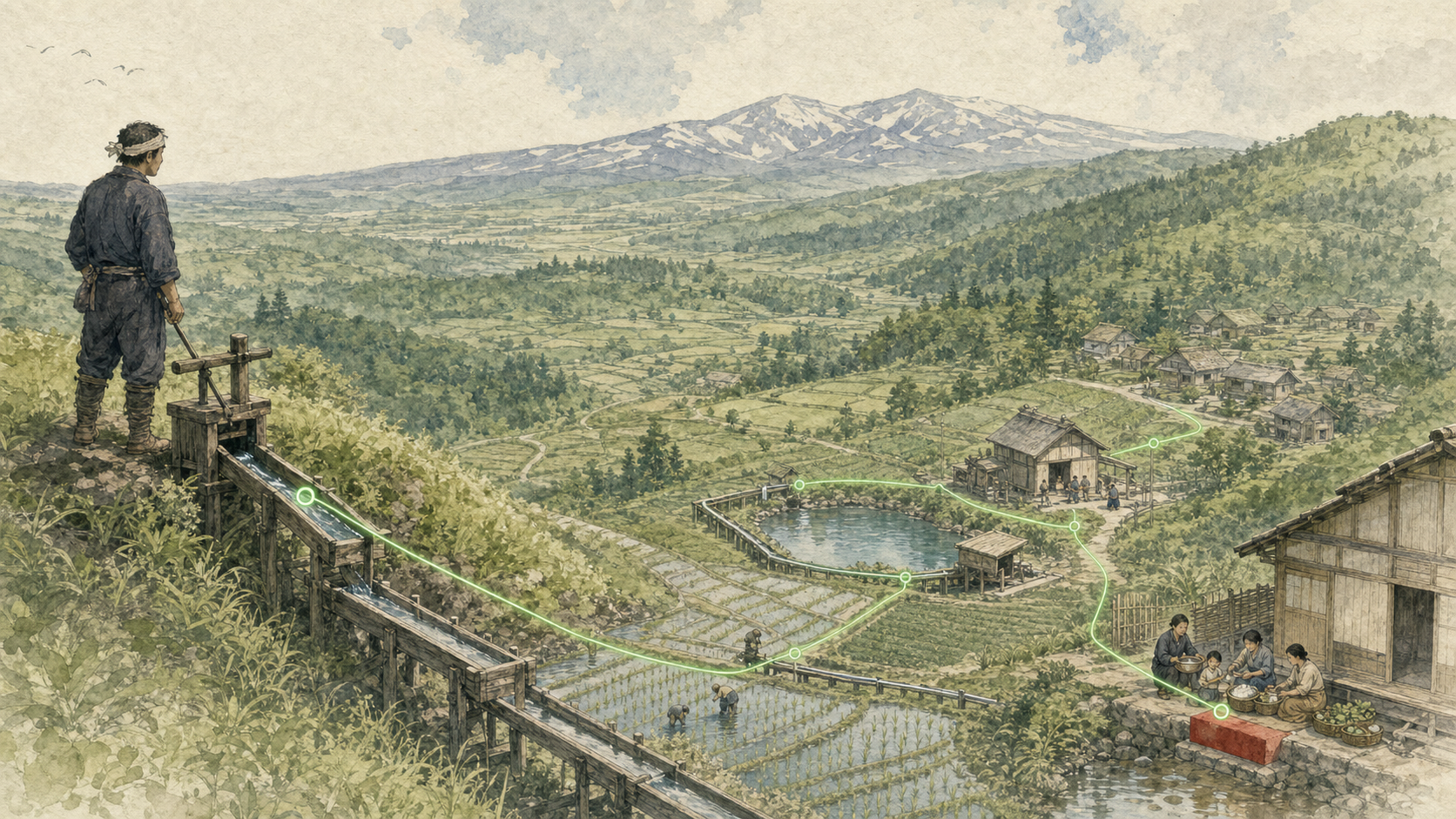
Years ago, at Morgan Stanley, I was required to attend an MD town hall — Vice Presidents didn't get to skip these. Fifteen hundred people worked in my office alone, with offices in every country; an organization that size generates a gravity of its own, and it's easy to spend a career orbiting inside it. The Managing Director's message that day was aimed at exactly that. Everything this firm does, she said, ultimately serves a client. A few of you manage clients directly. Everyone else is part of a giant support structure around that service. You may be many degrees of separation from any client — but there is a line from your desk to them. Know who you serve. Know the path that reaches them. Then align everything you do to it.
She had my number. I'd spent a significant part of my career provisioning firewall rules — about as deep into the back of the back office as you can get, and about as many degrees from a client as the org chart allows. From that seat it is remarkably easy to lose sight of how anything interrelates, let alone where your own work aligns with the whole. The reminder was necessary.
I've never forgotten it, because it generalizes far beyond one bank. Every system anyone builds has a downline — a chain of consequences that terminates somewhere, in someone. Most builders never trace it. This essay is an argument that, with AI, knowing your downline is not a virtue but a responsibility — ours, because humans are in charge.
The premise
Start from a claim few will contest: AI should benefit humanity. The trouble is that the claim is so agreeable it constrains nothing. Every pitch deck asserts it. To make it mean something, we need to say what "benefit" is — and for that I'll borrow an old scaffold.
Maslow's hierarchy of needs is contested science and I won't pretend otherwise — the man never even drew the famous pyramid. But as a map rather than a law, it has held up for a reason: human energy is finite, and energy spent securing food, water, shelter, and bodily safety is energy unavailable for everything above — connection, mastery, contribution, meaning. The bottom layers are not where humans flourish. They are what flourishing has to pay for first.
So here is the goal, stated plainly: AI and robotics — I mean them together — should be aimed at putting the base of the pyramid on autopilot. Reliable, boring, automated provision of subsistence: growing clean food, making clean water, building and maintaining basic shelter, supporting the health of the population. Not luxury — staples. A floor, not a lifestyle. Nobody dreams of a diet of staple crops, and that's fine; the point of a safety net is not that you want to live in it. The point is that with the net in place, humans stop spending themselves on subsistence dread and start spending themselves on everything the pyramid puts above it.
This essay stays on that bottom layer — the physiological needs.
Not a ban — a direction
Let me head off a misreading. I am not proposing to prohibit AI that does something other than grow food. Most of the economy does something other than grow food. The proposal is about direction: as a society, we should set the goal — incentivize developments and applications that move people up the hierarchy, and disincentivize those that push people down it. What that requires first is not legislation. It's an instrument — a way of telling which is which.
The instrument: trace the downline
The MD's method scales perfectly. For any AI system — yours, your employer's, the one in the pitch you're reading — play the line through. However many degrees of separation, follow the sequence until you reach actual people, and ask what it does to their footing on the pyramid.
Run it honestly and I don't think you'll find a neutral. Every line, played all the way through, ends somewhere on the pyramid — and it points up or it points down. What varies is not the direction but the distance: some systems act on human footing directly, most act through the fabric around them. So the grading has two directions and two modes.
Directly elevating. The downline terminates in subsistence, health, or capability itself. Autopilot agriculture. Water purification. Diagnostic systems reaching populations that have no doctor. Robotics that build and maintain housing. Logistics that make the staples cheap and reliable. AI as infrastructure for the floor.
Indirectly elevating. The downline runs through the support fabric that makes the direct work possible — and that fabric is not neutral; it is load-bearing. The MD's town hall is the proof: fifteen hundred people, a handful facing clients, and the firm treated every back-office desk as part of the service, because it was. The same holds at society's scale. The sales system that keeps a seed company solvent, the logistics platform, the governance tooling that helps institutions adopt AI without losing control of it — none of these grows food, but trace the line: they are part of the fabric that lets the farmer farm. Honest entertainment belongs here too — rest that restores people to their footing is part of the fabric. The test isn't proximity to a farm. It's whether the line, played all the way through, participates in human footing or merely claims to. Benefiting a company is fine; it just isn't automatically benefiting humanity, and the whole discipline is refusing to let the second claim ride for free on the first.
Degrading — directly or indirectly. The downline terminates in diminished people. Directly: systems engineered for compulsion — that monetize attention beyond intention, sleep, insecurity, loneliness; the machinery I've written about in the Hacking Humans series. Their business model is the descent: they profit precisely to the degree that users lose footing — time, money, self-regard, agency. And indirectly: the fabric that supplies them — the tooling, the placement networks, the optimization services that exist to make the compulsion machinery run better. A support structure inherits the direction of what it supports.
That last sentence is the uncomfortable part of the grading, and I'll state it plainly: there is no seat so deep in the back office that the line stops reaching you. Mine didn't stop at the firewall rules. The direction of your downline is the direction of your work.
AI has a pharmacology
We have run this exact exercise before, with molecules. Some drugs are medicine: they cure, treat, restore people to their footing. Some are recreation with a corrosive edge: no therapeutic benefit, real capacity for harm. Same chemistry in the abstract — opposite downlines. Learning to tell the difference, compound by compound, is called pharmacology, and we built it before and apart from any question of what to prohibit.
AI needs its pharmacology. Not a scheduling regime — I'm not proposing a DEA of algorithms, and this essay is deliberately not a policy paper. What I'm proposing is upstream of policy: the shared awareness that the same underlying technology divides into medicine and intoxicant depending entirely on where its downline ends, and a habit of actually checking. A nutrition label, not a prohibition. Once that legibility exists, incentives can find it — investors already read labels; so do talented engineers deciding where to spend a career. How a society formalizes the incentive is a question for another writer or another day. The seeing comes first.
Know your line
Which returns me to that town hall. The MD wasn't making policy either. She was issuing an instruction for self-awareness: you have a line; know it. Fifteen hundred people in one office needed reminding that their work terminated in a client. The builders of the most consequential technology of our era need the same reminder, with one substitution — your work terminates in a human being's footing on their own life.
So, wherever you sit in the machine: play it through. Count the degrees of separation if you must, but follow your system's consequences until you reach a person, and ask which way you're moving them. Up the pyramid, or down.
If the answer is up — build faster. We have a floor to finish.