Article
An Ecosystem of the Accountable
Why stable AI ecosystems require more than distributed value: every agent must act under a named human principal who remains answerable for the outcome.
Satya Nadella recently wrote that "a frontier without an ecosystem is not stable." His argument runs on economics: if the value of the AI transition accrues to a handful of frontier models — models that learn from everything they touch — the rest of the economy hollows out, and neither markets nor politics will tolerate that world for long. His prescription is for firms to keep control of their intellectual property and to keep investing in human capital alongside token capital, so that human expertise remains valuable as AI grows.
He is right. And I want to extend the argument one layer down, because value is not the only thing that must stay distributed for the frontier to be stable.
Accountability must stay distributed too.
You cannot put a model in jail
Consider what we actually do when things go wrong.
We fine companies. We sanction professionals. We revoke licenses. In the worst cases, we put people in jail. And in the everyday cases — the ones that never reach a courtroom — we do something softer but just as important: we hold people to their word. We ask them to explain themselves. We adjust how much we trust them next time.
None of this works on an AI model.
You cannot fine a model. You cannot jail it. There is very little point in scolding it. A model has no assets to forfeit, no liberty to lose, no reputation it cares about, no future it is trying to protect. Every mechanism our institutions use to enforce responsibility — legal, financial, social — assumes a party with something at stake. A model has nothing at stake.
This is not a complaint about AI. It is a fact about accountability.
Unpredictability is not the problem
Here is the objection I hear most often: AI is unpredictable, so it cannot be trusted with real work.
But humans are unpredictable too. Any lawyer, any manager, any parent knows this. We have never required predictability before extending trust. What we require is answerability. A surgeon's hands can slip. A pilot can misjudge. An engineer can be wrong. We accept a degree of variance in every human endeavor — because when the variance produces harm, there is someone to answer for it. Someone who can explain, compensate, improve, or be removed.
So the dividing line between humans and AI is not reliability. Both are fallible. Both carry irreducible randomness. The line is that a human can be held accountable and a model cannot.
That line does not disappear as models improve. A model that errs once in a million runs is still a party that cannot answer for the one error.
What an ecosystem is actually made of
This is where Nadella's word — ecosystem — earns its keep, and where I want to be precise about what it means.
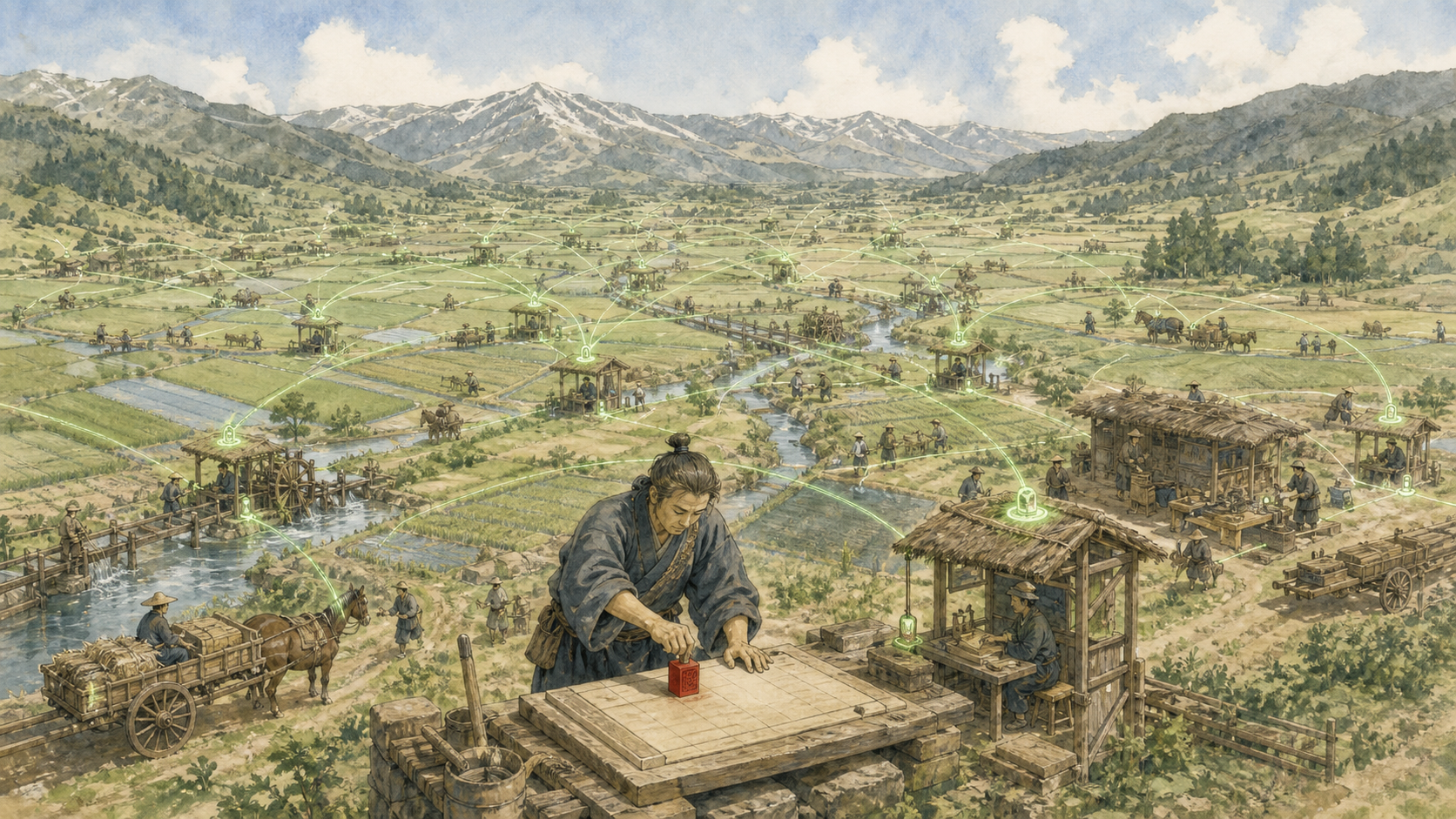
An ecosystem is not merely a distribution of value. It is a web of parties who answer to each other. Suppliers answer to customers. Firms answer to regulators. Professionals answer to their clients and their licensing bodies. Executives answer to boards. The stability of the whole arrangement comes from the fact that every node in the web is a party with something at stake — a party that can be held to account.
An economy where AI does more and more of the work does not escape this requirement. It sharpens it. The more work is performed by parties that cannot be held accountable, the more important it becomes that every piece of that work traces back to a party that can.
In law, there is an old and precise word for this arrangement: agency. An agent acts under the authority of a principal. The agent does the work; the principal answers for it. Authority flows down; accountability flows up. The chain must terminate somewhere — and it must terminate in a person, because a person is the only kind of party our institutions know how to hold responsible.
AI has made the word "agent" fashionable again. We should recover its full meaning. An agent without a principal is not an innovation. It is a gap in the web — work happening with no one answerable for it. Enough gaps, and the web is no longer an ecosystem. It is a frontier without one.
Humans are in charge
I read Nadella's essay as a warning delivered at the scale of firms and markets: keep your value, keep your expertise, or the transition destabilizes.
The same warning, delivered at the scale of individual work, sounds like this: keep your name on it.
Every task an AI performs should be performed under someone's authority — a named person who set the purpose, defined what done looks like, and stands behind the outcome. Not because the AI is dangerous, but because work without an answerable party is work our institutions cannot absorb. Courts cannot judge it. Markets cannot price the trust in it. Colleagues cannot rely on it.
This is, I think, the most optimistic reading of the moment. If accountability cannot be automated — and it cannot — then the human role does not shrink as AI grows. It concentrates. Judgment, purpose, and answerability become the scarcest inputs in the whole system. The models multiply; the people willing to put their name on the outcome do not.
A frontier without an ecosystem is not stable. And an ecosystem, at bottom, is not made of value flows or IP portfolios. It is made of people who answer for things.
AI does the work. Humans are in charge. That is not a limitation on the technology. It is the condition under which the technology gets to matter.